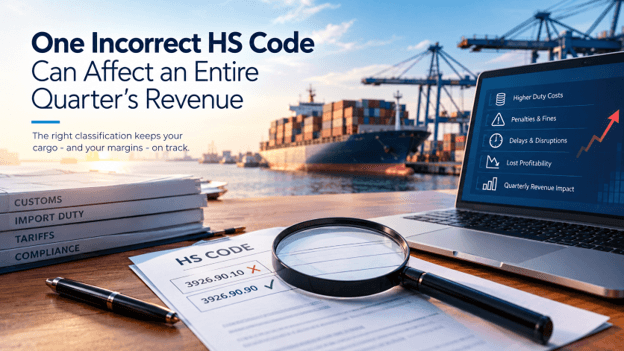
One Incorrect HS Code Can Affect an Entire Quarter's Revenue
One incorrect HS code can do more than delay a shipment. It can create repeated duty discrepancies, unexpected compliance costs and pressure on quarterly margins. Discover why classification accuracy matters in 2026 and five practical steps importers can take to reduce risk.
Editorial Desk
Oct 14, 2026
9 min read
The Smallest Number Can Create the Biggest Cost
A shipment clears customs. The goods arrive on time. The invoice is paid. Everything appears to be running smoothly.
Then a customs review identifies one incorrect HS code.
What initially looks like a minor documentation error can reveal a much larger problem: duty calculated at the wrong rate, import VAT implications, unexpected compliance costs and similar errors repeated across hundreds of shipments.
For businesses importing regularly, the financial impact may extend well beyond a single consignment. It can affect margins, working capital and quarterly financial performance.
This is particularly relevant for UK importers in 2026. HMRC updated its guidance on customs civil penalties on 31 July 2026, while the Chartered Institute of Export & International Trade highlighted classification errors among the common causes of customs duty underpayments in February 2026.
The message for businesses is clear: HS code accuracy is not simply a customs requirement. It is part of financial risk management.
What Is an HS Code, and Why Does It Matter?
The Harmonized System (HS) is an internationally recognised framework used to classify traded goods. The World Customs Organization (WCO) maintains the system, which provides a common foundation for customs classification across international markets.
The first six digits are harmonised internationally, while individual customs territories can extend codes to provide more detailed product classifications.
For UK imports and exports, the relevant commodity code helps determine customs duty rates, applicable trade measures, documentation requirements and whether specific licences or approvals are needed.
HMRC explains these requirements in its official guide to finding commodity codes for imports and exports. For a broader UK exporter overview, see our guide to understanding commodity codes.
The challenge is that products cannot always be classified accurately by their commercial names alone. Their composition, function, technical specifications and intended use can all matter.
Two products that look similar may fall under different classifications. Using a supplier's existing code without checking its suitability for the destination market can therefore create avoidable exposure.
How One Incorrect HS Code Can Affect an Entire Quarter
The financial consequences rarely stop at the original declaration.
1.Incorrect duty calculations can erode margins
Customs duty is generally calculated using the applicable duty rate and customs value, subject to the relevant rules and measures.
If a product is declared under a code carrying a lower duty rate than the correct classification, the business may underpay duty. If the rate is higher than necessary, it could overpay and tie up cash unnecessarily.
Consider a hypothetical example.
An importer receives 400 consignments during a quarter. An incorrect classification creates an average customs duty difference of £25 per consignment.
That produces a potential duty discrepancy of £10,000 across the quarter.
This is an illustrative calculation, not a typical industry loss or a prediction of HMRC's assessment. Actual exposure depends on the products, customs values, applicable rates and number of affected declarations.
For a business operating on tight margins, even a relatively small repeated error can reduce the profitability of an otherwise successful trading period.
2.Repeated errors can turn into compliance liabilities
A code used incorrectly once may be an isolated mistake. The same code copied across purchase orders, product databases and recurring shipments can become a systematic control failure.
HMRC's Customs Notice 301 on civil penalties, updated in July 2026, explains how penalties may apply to customs contraventions. Depending on the circumstances, the maximum penalty can reach £2,500 per contravention under the framework described in the notice.
The guidance also identifies circumstances in which serious errors can attract penalties on a first contravention. The outcome depends on the nature and severity of the error and other relevant factors.
Businesses should therefore avoid assuming that an incorrect classification will automatically be treated as a minor administrative issue.
3.Customs delays can disrupt sales and operations
Commodity codes do more than influence duty calculations. They can also determine whether additional declarations, licences, certificates or other controls apply.
An incorrect code may result in a rejected declaration, a request for further information or additional checks before goods can be released.
For a manufacturer waiting for production components, a distributor preparing for a seasonal sales period or a retailer replenishing fast-moving stock, the consequences can spread through the operation.
Additional storage, handling, transport changes and missed delivery commitments can increase costs. If stock becomes available later than planned, the business may also lose sales opportunities.
These indirect costs can be difficult to identify in a customs account because they may appear under separate operational budgets.
4.Financial reporting can hide the underlying problem
The timing of a classification error matters.
A shipment may clear in one month, but the financial consequences of an incorrect declaration may only become apparent during a later review. Repeated errors can therefore create discrepancies between the costs originally forecast and the liabilities eventually identified.
The impact depends on the circumstances and accounting treatment, but businesses may need to revisit landed-cost assumptions, inventory costs, margin analysis or provisions for potential liabilities.
For finance teams, this makes customs data relevant to more than logistics reporting. It can influence how accurately the business understands the true cost of imported products.
Why HS Code Accuracy Deserves Attention in 2026
The regulatory environment makes regular classification reviews especially important.
First, HMRC continues to publish updates to customs declaration requirements. Its Customs Declaration Service guidance includes declaration instructions updated in October 2026. Businesses should check the applicable guidance when preparing declarations rather than relying solely on historic procedures.
Second, international classification frameworks evolve. The WCO has published information on the HS 2028 amendments, including changes relating to selected product categories and emerging trade priorities. These amendments are a future change to prepare for, not a blanket replacement of all existing codes in October 2026. Businesses should monitor the applicable implementation arrangements for their trading markets.
For importers with large product catalogues, these developments reinforce the need for a documented process to review classifications, check changes and update internal product records when required.
Five Practical Ways to Reduce HS Code Risk
Reducing classification risk requires a repeatable process rather than a one-time code check.
Verify the product, not just its name. Gather technical specifications, composition, function, intended use and supporting product documentation before selecting a code.
Use the destination country's official tariff tools. UK businesses can consult the GOV.UK Trade Tariff service to check commodity codes, duty rates, VAT and relevant trade measures.
Review recurring products periodically. Prioritise high-volume, high-value and frequently imported products. A code that is reused across hundreds of declarations deserves stronger controls than an unreviewed spreadsheet entry.
Keep evidence of classification decisions. Maintain product specifications, supplier information, technical reasoning, correspondence and records of any formal classification decisions. Where classification remains uncertain, consider applying for an appropriate legally binding ruling through the relevant customs authority. HMRC explains the process in its guidance on legally binding commodity-code decisions.
Reconcile customs declarations against business records. Compare declared codes, customs values, duty calculations and supporting documents. Investigate repeated discrepancies early and establish a clear procedure for correcting errors where necessary.
These checks become particularly valuable when procurement, finance, warehouse and customs teams maintain separate systems or use different product descriptions.
How the Right Logistics Partner Can Help
Customs classification should not be treated as an isolated task at the end of the shipping process. It needs to connect with product information, commercial documentation, customs declarations and shipment planning.
A logistics partner with customs expertise can help businesses coordinate these activities, identify missing information and reduce avoidable declaration risks.
At Clarusto Logistics, our customs clearance services cover classification support, duty calculations, documentation and customs compliance. Integrating these checks with freight forwarding helps businesses manage shipments with greater visibility across the movement.
Responsibility for providing accurate product information and meeting applicable customs obligations must still be clearly agreed between the importer, exporter and any appointed representative. A logistics partner supports the process; it does not eliminate the need for sound internal controls.
Conclusion: Protect the Margin Before the Quarter Closes
An incorrect HS code can appear insignificant when viewed against a single shipment. Repeated across a product range or an entire quarter, however, it can create avoidable duty discrepancies, compliance exposure, operational disruption and unexpected costs.
The most effective response is proactive: verify classifications, retain supporting evidence, monitor tariff changes and review declaration data regularly.
Because the real cost of a classification error is not always the amount attached to one shipment. It is the cumulative impact on the business.
Planning an international shipment? Speak to Clarusto Logistics about customs clearance and documentation support designed to help your cargo move with greater confidence.
This article is for general information and does not constitute legal, customs or tax advice. Classification and liability depend on the specific goods, applicable tariff and facts of each transaction.
An incorrect code may result in underpaid or overpaid customs duty, incorrect tax treatment, declaration amendments, delays, additional checks or penalties, depending on the circumstances.
Can an HS code error affect quarterly profits?
Yes. If the error is repeated across multiple shipments, the cumulative duty discrepancy and associated costs can reduce margins and affect cash flow. The actual accounting impact depends on the circumstances.
Who is responsible for the correct HS code?
Responsibility depends on the applicable customs rules, the parties involved and their roles in the declaration. Importers should establish clear arrangements with suppliers, customs representatives and logistics providers rather than assume that delegating a declaration transfers every obligation.
How do I check the correct HS code for UK imports?
Use the official UK Trade Tariff, supported by accurate product specifications and relevant classification guidance. Seek a formal ruling when appropriate if the classification remains uncertain.
How often should commodity codes be reviewed?
Review codes when product specifications change, new products are introduced, tariff measures are amended or a potential classification error is identified. Periodic checks of frequently imported products are also advisable.