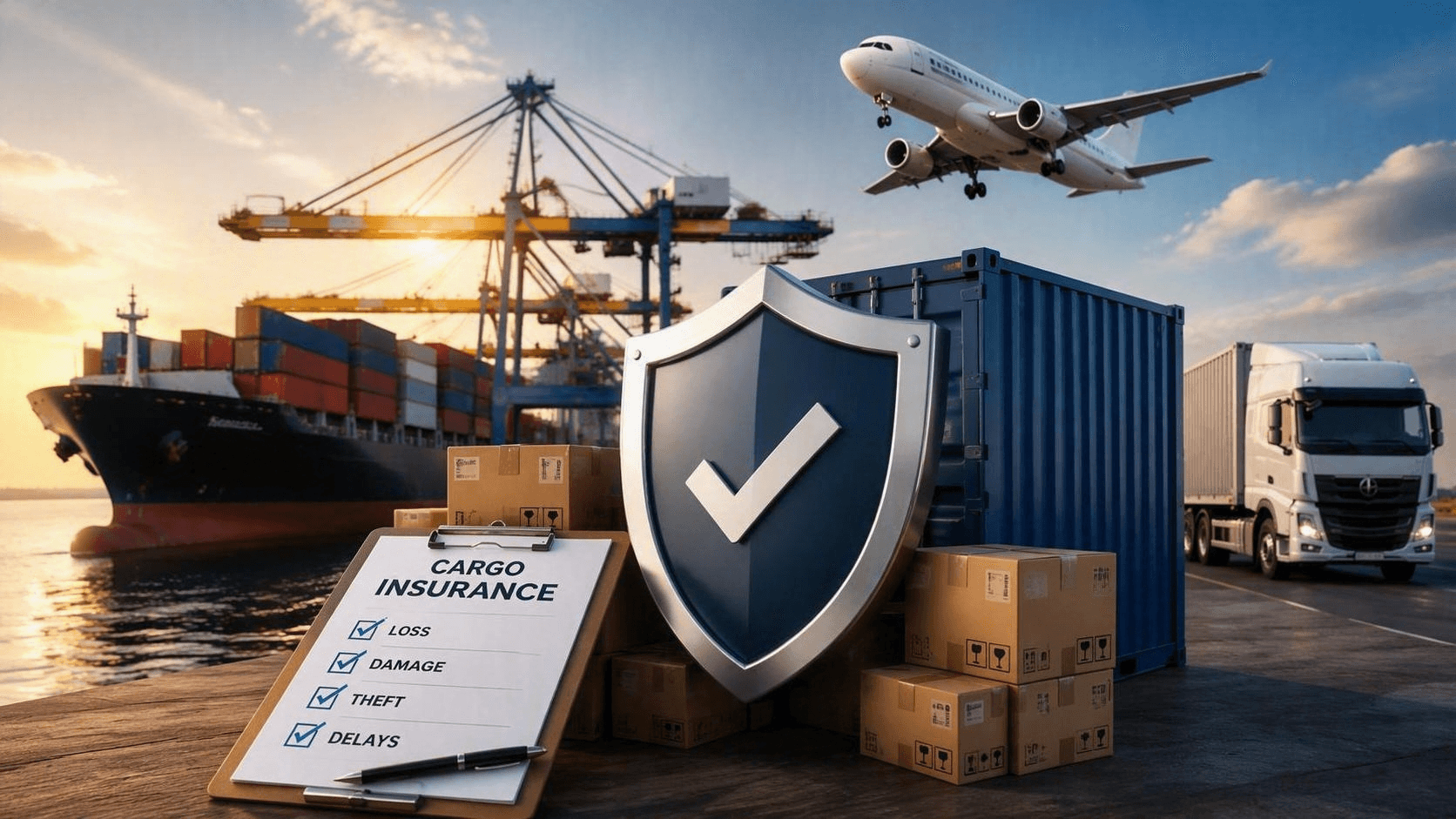
Cargo Insurance Explained: A UK Guide for Importers & Exporters
Cargo insurance can protect UK businesses against covered loss or damage to goods in transit. Learn what cargo insurance covers, how Incoterms affect insurance and what importers and exporters should check before shipping.
Editorial Desk
Sep 02, 2026
9 min read
Cargo insurance can protect businesses against financial losses when goods are lost or damaged during transportation. But what does it cover, who needs it, and how does it work with Incoterms?
For UK importers and exporters, international shipping involves more than freight costs and delivery schedules. Goods may pass through warehouses, ports, airports, carriers and multiple handling points before reaching their destination.
Cargo insurance can help businesses manage the financial risk associated with loss or damage to goods in transit.
However, cargo insurance is not the same as carrier liability, and having an Incoterm that mentions insurance does not necessarily mean your goods have comprehensive protection.
Here is what UK businesses need to know.
What Is Cargo Insurance?
Cargo insurance provides financial protection for goods against covered risks while they are being transported.
Coverage depends on the policy wording, insured value, exclusions, transport route and type of goods.
For businesses shipping high-value machinery, electronics, automotive components, pharmaceuticals or other commercially important goods, appropriate insurance can be an important part of supply chain risk management.
Is Cargo Insurance Mandatory in the UK?
Cargo insurance is not generally compulsory for every shipment.
However, insurance may be required by:
A sales contract
An agreed Incoterm
A bank or financing arrangement
A customer's terms
A specific commercial agreement
UK businesses should therefore establish who carries the risk during transportation and whether existing protection is adequate before shipping.
HMRC explains that Incoterms clarify responsibilities, costs and risks between buyers and sellers.
Cargo Insurance vs Carrier Liability
These are often confused.
Carrier liability refers to the carrier's legal or contractual responsibility for cargo. Depending on the transport arrangement and applicable rules, liability may be limited.
Cargo insurance is specifically designed to protect the insured goods according to the policy's terms and conditions.
For example, a business shipping £100,000 of equipment should not automatically assume that the carrier will compensate it for the full £100,000 if the shipment is damaged.
The key point: carrier liability does not automatically equal full cargo-value protection.
What Does Cargo Insurance Cover?
The exact protection varies between policies, but cargo insurance can cover specified risks such as:
Accidental physical damage
Theft
Loss
Fire
Collision
Certain weather-related events
Damage during transportation or handling
Businesses should carefully check exclusions and conditions.
Depending on the policy, exclusions can include inadequate packaging, normal wear and tear, inherent deterioration, certain delays and specific war or political risks.
"All risks" should not be interpreted as "everything is covered."
The policy wording determines the actual protection.
Institute Cargo Clauses A, B and C
Businesses involved in international shipping may encounter the Institute Cargo Clauses (ICC).
Clause A
Generally provides the broadest standard level of cover of the three main clauses, subject to exclusions.
Clause B
Provides narrower protection based on specified insured risks.
Clause C
Provides more limited cover and is commonly associated with minimum insurance requirements under certain Incoterms arrangements.
The appropriate level depends on the cargo, route, value and risk exposure.
How Do Incoterms Affect Cargo Insurance?
Incoterms are particularly important because they establish responsibilities and risk allocation between buyer and seller. For a deeper overview, see Decoding Incoterms 2020.
CIF – Cost, Insurance and Freight
CIF is used for sea and inland waterway transport.
Under CIF, the seller arranges and pays for freight and insurance to the named destination port. However, HMRC notes that the seller is required to obtain minimum insurance cover under CIF. A buyer wanting greater protection may need additional insurance.
CIP – Carriage and Insurance Paid To
CIP can be used for any mode or combination of transport.
The seller arranges carriage and insurance to the named destination. Businesses should still check the precise insurance terms rather than assuming the cover meets their full requirements.
UK government guidance confirms that Incoterms establish who arranges transport and insurance and who carries associated responsibilities.
Important: An Incoterm tells you how responsibilities and risks are allocated; it does not automatically mean your cargo has comprehensive insurance.
How Much Cargo Insurance Do You Need?
The correct insured value depends on the transaction and policy.
Businesses may need to consider
Value of the goods
Freight costs
Insurance costs
Duties and related costs where applicable
Additional agreed amounts
Do not automatically assume that the invoice value is the correct insurance value.
UK customs valuation rules can also affect how insurance and delivery costs are treated when goods are imported. HMRC provides specific guidance on which delivery-related costs may need to be included in customs value.
What Should You Do If Cargo Is Damaged?
If goods arrive damaged or are lost, act quickly.
Keep relevant documentation, including:
Commercial invoice
Packing list
Bill of lading or airway bill
Insurance documents
Delivery records
Damage reports
Photographs
Survey reports, where applicable
Correspondence with the carrier
Photograph damaged packaging and cargo before disposal or repair where practical.
Prompt notification can also be important because insurance policies may contain specific claim notification requirements.
How Can UK Businesses Reduce Cargo Risk?
Insurance is only one part of effective cargo risk management.
Businesses should also
Use appropriate packaging suitable for the cargo and transport method
Choose suitable transport based on value, fragility and urgency
Understand the Incoterm and when risk transfers between buyer and seller
Check exclusions — don't select a policy based solely on headline price
Declare cargo accurately with correct descriptions and values
Maintain organised shipping, commercial and insurance records
Work with experienced logistics partners to reduce avoidable handling and documentation risks
UK government guidance also recommends ensuring freight is properly insured and highlights the role freight forwarders can play in helping businesses manage this risk. See what a freight forwarder actually does.
Cargo Insurance with Clarusto Logistics
Cargo insurance should be considered alongside freight planning, customs and documentation—not as an afterthought.
Clarusto Logistics helps UK businesses coordinate international freight forwarding, customs clearance and supply chain logistics across global trade routes.
From sea and air freight to road transportation and multimodal shipments, the right logistics approach can help businesses maintain greater visibility and control over their cargo.
No. It is not generally mandatory for every shipment, although contractual, commercial or financing requirements may make insurance necessary.
Does cargo insurance cover the full value of my goods?
Not automatically. The insured amount, policy limits, exclusions and conditions determine what can be recovered.
Does CIF provide full cargo insurance?
No. CIF requires the seller to arrange minimum insurance cover. Additional protection may be required depending on the buyer's needs.
Is cargo insurance different from carrier liability?
Yes. Carrier liability is the carrier's responsibility under applicable contracts and rules, while cargo insurance provides separate insurance protection subject to its policy terms.
Can cargo insurance cover air and road freight?
Yes. Cargo insurance can be arranged for sea, air, road and multimodal transportation, depending on the policy.
Should UK exporters consider cargo insurance?
Yes, particularly when transporting high-value, fragile, specialist or commercially important goods.